

60-Second Summary
Reverse logistics—managing product returns and excess inventory—is critical for industries like retail, healthcare, and electronics, yet traditionally manual processes can be slow, costly, and error-prone. By leveraging technologies such as automated sorting systems, AS/RS, automation software, and AI/ML, businesses can streamline returns, reduce costs, improve customer experience, and boost profitability. OPEX® offers advanced automation solutions like Sure Sort® and Perfect Pick® to optimize reverse logistics, helping businesses recover value from returns while enhancing efficiency and sustainability.
Whether you’re an up-and-coming e-commerce vendor or a seasoned warehouse manager, you’ve likely managed returns or product disposals due to deadstock and excess inventory. These are key activities of reverse logistics, the process of moving products back to the manufacturer or seller from the end user. For processes to be classified as reverse logistics, items must move backward in your supply chain flow.
Reverse logistics traditionally relies on a human workforce for sorting, processing, and handling returns. However, manual workflows often lead to delayed processing times, higher error rates, and excessive operational expenses. Technological innovations such as automation, artificial intelligence (AI), and machine learning (ML) have transformed reverse logistics, allowing businesses to manage returns seamlessly.
The Importance of Optimizing Reverse Logistics Operations
For the retail, health care, and electronics industries, reverse logistics are critical, as product returns and disposals are regular occurrences. In 2023, almost $744 billion of products were returned in the United States. Many businesses and warehouses face a dilemma: refusing returns can negatively impact sales, while accepting products back may significantly strain profits.
By implementing automation and other technologies, you can minimize returns and streamline your business’s return-handling processes. With enhanced workflows for tasks related to sorting, processing, and more, inventory can move through your supply chain to be available for sale again, potentially recovering income. Rather than viewing returns as an unavoidable burden, optimize reverse supply chain operations to reduce costs and losses and increase profitability.
4 Technologies That Can Optimize Reverse Logistics
Here are four technologies you can implement to improve your reverse logistics operations.
1. Automated Sorting Systems
Depending on your industry, processing returns likely involves sorting return items into one or more of the following categories:
- Repair
- Repackage
- Recycle
- Recall
- End-of-life
- Resell
Manual sortation is time-consuming and labor-intensive. Automated sorting systems make this process significantly more efficient. These systems eliminate the need for human intervention, automatically organizing items according to specific criteria and determining how goods will be sorted. Using robotics and scanners, returned items are reintroduced into the system, scanned, and sorted into the appropriate bins, ready for the following stage of your business’s reverse supply chain.
Automating sortation allows your operation to handle a much higher volume of returns with greater speed and efficiency. This reduces the need for workers to perform repetitive tasks, minimizing labor costs. You can also get products back on the shelves faster, potentially allowing them to be sold again.
Automation may help reduce return rates, resulting in further savings as the costs of processing the return can be up to 66% of the product’s price. Automated sorting helps avoid mistakes such as picking the incorrect products or misrouting packages when used to enhance order fulfillment. About 23% of consumers who request returns were sent to the wrong item.
2. Automated Storage and Retrieval (AS/RS) Systems
Once returned items have been sorted into categories, they must be stored in the appropriate location. When your operation relies on manual labor to put away inventory, there’s a higher risk of lost or damaged inventory. Employees also typically spend a lot of time navigating the warehouse floor to find the allocated shelving or racking. Some workers have reported walking up to 10 miles daily to complete tasks.
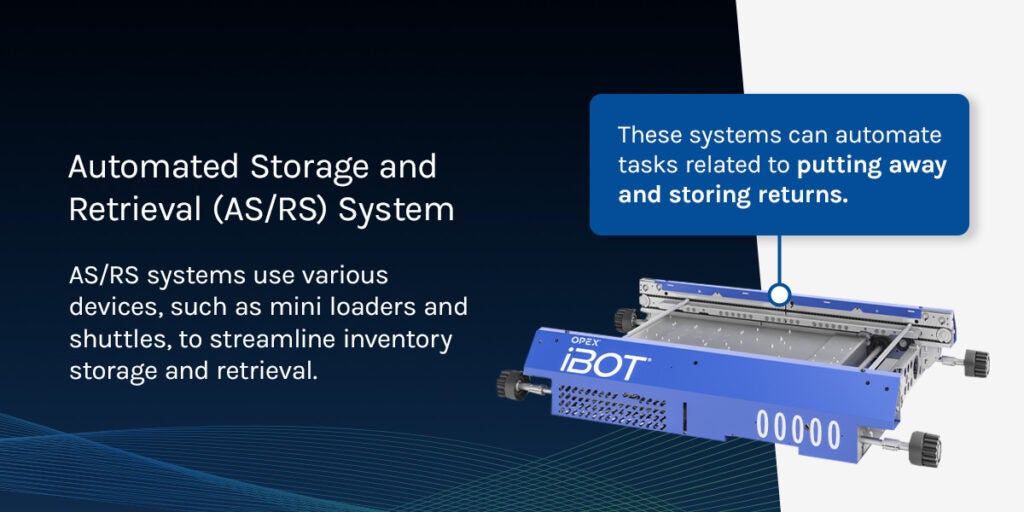
AS/RS systems use various devices, such as mini loaders, robots, and shuttles, to streamline inventory storage and retrieval. These systems automate tasks related to putting away and storing returns and help speed up product exchanges.
3. Automation Software
Automation software can allow your operation to process returns much more efficiently. This software can also offer valuable insights about product returns, enabling you to monitor the recovery of your business’s assets and control product refurbishment or repair.
To optimize your reverse logistics operations, you can implement the following software:
- Warehouse management system (WMS): A WMS is essential to processing returns promptly. It allows you to manage all functions of warehousing operations, including receiving, storage, item picking, packing, and shipping.
- Inventory management software: Also known as inventory management systems, this software is typically integrated with a WMS. It oversees inventory across your supply chain, giving you visibility of stock levels and statuses you can use to better manage returned items.
- Order fulfillment software: While this software mainly manages tasks related to order fulfillment, it also helps you understand why items were returned and make data-driven decisions about handling returns.
- Returns management system (RMS): These platforms are an end-to-end solution that consolidates all workflows and data relating to returns into one centralized location. RMS also automates tasks like return shipping label generation and return policy enforcement while offering advanced return analytics and real-time tracking.
4. AI and ML
AI and ML can be particularly valuable if you handle high return volumes. AI can analyze large amounts of data to assess factors such as:
- The condition of items.
- When items were purchased.
- The demand and resale value of items.
- The cost to repackage items.
Based on this analysis, AI and ML technologies also enhance return routing, quickly identifying where returned items should go next in the supply chain and how they should be handled, whether it’s refurbishment, resale, donation, or disposal.
The Benefits of Leveraging Technology in Reverse Logistics
Automation, warehouse software, AI, and ML are undeniably valuable tools for reverse logistics and can benefit your operation in the following ways:
- Streamlined returns processing: Manual return handling is typically error-prone and labor-intensive. Systems that automate tasks such as return authorization, product inspection, sorting, and routing tasks help minimize mistakes, speed up processes, and increase customer satisfaction in returns management. As a result, you can boost your overall operational efficiency due to higher throughputs and resource reallocation.
- Reduced costs: As these technologies can increase your operation’s efficiency, you’ll typically experience correlated reduced costs. Along with effectively managing your resale, refurbishment, and disposal processes to maximize income recovery, automation technologies reduce your reliance on human intervention, lowering expenses associated with labor. You can redirect these savings to other aspects of your operation, reinvesting the savings for a higher ROI.
- Improve the customer experience: With the right technology, you can provide customers with easy-to-use online portals for hassle-free returns. You can also share real-time updates regarding their return’s status, such as whether it has been accepted or if there is a reason for rejected items. With the reduction in costs, you have the financial capacity to offer free shipping for returns, helping retain customers and create a more convenient experience.
- Increase transparency and visibility: Tools such as GPS tracking can help you stay updated in real time with the location and ETA of returned shipments, helping you plan and streamline operations for higher outputs. Automation software increases visibility throughout the entire reverse supply chain, from transparency of stock levels to information regarding essential workflows.
- Optimize inventory management: Proper inventory management in reverse logistics is critical. When products are returned, they must be accounted for in inventory levels. Automation technologies and software easily track the status of returned items, which need to be disposed of, repaired, or resold. As large volumes of returned products may lead to an unexpected excess of inventory, having an immediate oversight into stock levels can help avoid overstocking.
- Enhance data analytics: Automation software, AI, and ML offer advanced analytics capabilities that allow you to gain crucial insights from data generated by returns. Based on this data, these technologies can identify patterns, forecast return rates, and determine customers’ reasons for returns, helping you make informed decisions to minimize future returns.
- Adopt eco-friendly practices: Automated sorting systems, AS/RS systems, AI, and ML can help you recycle materials and refurbish or repair products rather than dispose of them by identifying the product type and condition.
Optimize Your Reverse Logistics Operations With OPEX®
OPEX® is a trusted leader in warehouse automation with a deep understanding of the complexities businesses face with reverse logistics. By engineering and manufacturing automated sorting systems like Sure Sort® and Sure Sort X® and AS/RS systems like Perfect Pick® and Infinity®, we’re here to transform how you handle returns.
Beyond installing these cutting-edge systems, OPEX also offers training to help you unlock the full potential of your new equipment and 24/7 support to minimize downtime. To learn more about how our solutions can optimize your reverse logistics, contact us today.
Other Resources You Might Find Helpful
Leon County Supervisor of Elections Overhauls Its Manual Document Process, Saving Money for Taxpayers
OPEX® Falcon+® RED One-touch Scanning
Falcon® Scanner Demo
How Intelligent Scanning Cuts Costs and Drives ROI for BPOs
What is Right-Speed Scanning?
Enhancing Accessibility and Improving Service Delivery
Modernizing ECM/RIM Workflows: The Hidden Costs of Inefficiencies
Tectel SA Digitizes Medical Records for a Major Hospital with the Document Imaging Solution From OPEX®
The American Samoa DOE Streamlines the Digital Records Management Process
Powering Data-Driven Decision Making: Transforming Scanned Data into Actionable Insight
NEXT LEVEL AUTOMATION
Unlock Operational Efficiency with OPEX
OPEX is powering the future of automation. Contact us to learn more about how our vertically integrated automated solutions can help take your business to new heights.