

E-commerce warehousing efficiency directly impacts operational success through enhanced customer satisfaction, sustainable profitability, and reliable business performance. While traditional processes lack the adaptability and scalability to meet demands, automation offers a solution.
Warehouse automation is transforming operations by reducing errors, optimizing space utilization, increasing data availability, and informing decision-making processes. Advanced technologies and systems offer opportunities to streamline operations and optimize workflows without sacrificing quality.
Why Efficiency Matters
Efficiency directly impacts customer satisfaction, operational costs, and a company’s ability to compete in a dynamic, fast-paced market. As online shipping grows, customers expect accurate, rapid, and reliable delivery. Efficient warehouses pick, pack, and ship quickly and accurately, which reduces lead time and meets or exceeds customer expectations. Delays or errors in these processes can lead to lost sales, reduced customer loyalty, and damaged brand reputation.
From a cost perspective, efficient warehousing minimizes labor needs, storage requirements, and transportation expenses. Finding ways to streamline processes and reduce manual handling can lower expenses while optimizing processes. Efficient space utilization can also help reduce overhead costs. Businesses that can store inventory accurately without expanding their physical footprint can prevent stockouts or overstocking.
Additionally, efficiency enables scalability. E-commerce businesses often face order volume fluctuations during peak seasons and holidays. Efficient warehouse operations help businesses handle these changing demands without sacrificing speed or accuracy. Businesses with reliable information access can make informed decisions regarding purchasing, logistics, and other critical aspects.
Challenges With Traditional Fulfillment Processes
Traditional fulfillment processes face a range of challenges. As e-commerce grows and customer expectations rise, these challenges can have more significant implications. Some key issues include:
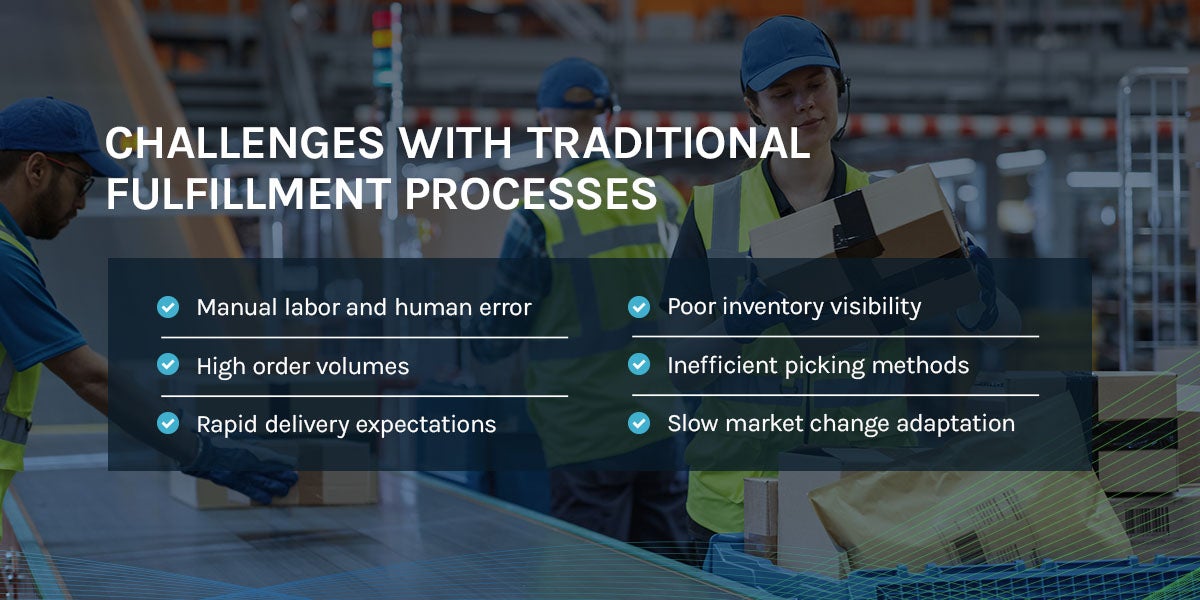
- Manual labor and human error: Traditional fulfillment relies on manual labor for picking, packing, and shipping processes. This dependence increases the risk of human error, which can damage customer trust and lead to expensive returns and reshipments.
- High order volumes: Manual processes can’t easily scale with order volume surges. Workers can only process a finite number of orders, leading to backlogs during peak seasons. Additionally, as pressure mounts to fulfill more orders, teams may face an increase in errors, such as mispicks or incorrect labeling.
- Rapid delivery expectations: Compared to automated systems, manual processes are inherently slower. Every step, from locating items to labeling a package, takes longer to complete. These inefficiencies make it difficult to meet same-day or next-day delivery expectations. Limited visibility also makes it harder to prioritize urgent orders or reroute resources to meet tight delivery windows.
- Poor inventory visibility: Many traditional systems lack real-time tracking and data availability. Manual processes rely on periodic counts or outdated software, which can result in inaccurate stock levels and insufficient decision-making. Businesses may face an increase in order delays, overstocks, or stockouts. Additionally, low visibility makes it difficult to forecast demand and plan replenishments effectively.
- Inefficient picking methods: Poor warehouse layout and diverse SKUs can drastically decrease efficiency. Traditional picking methods, such as single-order picking, often result in workers taking less efficient routes or missing the tools to quickly locate items as the SKU count grows.
- Slow market change adaptation: A lack of information access and dependence on slow and rigid processes impact an organization’s ability to adapt to market changes. Customer expectations and trends can shift drastically and suddenly, making it difficult for businesses without the right technology or solutions to stay competitive.
How Warehouse Automation Boosts E-Commerce Efficiency
Warehouse automation integrates advanced systems and technologies to optimize storage, retrieval, and sorting processes while maximizing vertical space utilization and throughput. Integrating software solutions and robotic systems has transformed labor-intensive, time-consuming practices into optimized workflows.
Automation also enables business scalability and flexibility. Automated solutions equip teams with the tools to handle sudden market shifts or increased volumes during peak seasons without raising proportional labor costs. Organizations can program automated solutions to optimize space and resources as workloads or inventory levels fluctuate. This flexibility means e-commerce businesses can consistently meet customer demands.
Automated systems can also collect and analyze information to shape future warehouse operation decisions. Teams can discover insights into productivity and inventory trends. Using a data-driven approach, businesses can support continuous improvement and ensure smarter and more effective decision-making.
Benefits of Warehouse Automation for E-Commerce
Warehouse automation has become a pivotal factor in e-commerce growth by transforming how organizations manage operations. Automation reduces the time it takes to fulfill orders and improves customer satisfaction through fewer errors and faster delivery times. Some of the top benefits of warehouse automation for online retailers include:
Increased Speed and Accuracy in Order Fulfillment
Warehouse automation dramatically accelerates operational processes. Systems like robotic pickers, sortation machines, and conveyor belts support faster processing than manual practices. Businesses can program these systems for enhanced precision, reducing errors. As a result, customers receive correct orders in a timely manner, boosting satisfaction and loyalty.
Labor Cost Reduction and Workforce Optimization
Automating labor-intensive or repetitive tasks allows organizations to reduce their reliance on manual labor. In addition to saving money on operational costs, teams can redeploy an existing workforce to more value-added roles like customer service and quality control.
Businesses can also strengthen their competitive position by overcoming labor shortage challenges and ensuring they can respond appropriately to quickly changing markets. Additionally, reducing manual labor can save an organization money by eliminating the need to dedicate resources to hiring, training, and managing staff.
Maximizing Storage Capacity and Space Utilization
Automated storage solutions, such as vertical lift modules and advanced systems, enable businesses to store more products without expanding their physical footprint. These solutions utilize high-density storage configurations that optimize space while simplifying operations for warehouse staff.
Additionally, these systems can access items stored at greater heights or in compact arrangements that would be impractical for a human workforce. Along with optimizing space, businesses can delay costly expansions and embrace a broader product range while streamlining workflows and reducing travel time.
Real-Time Inventory Visibility and Control
Businesses can gain inventory visibility and control with automation. Automated systems can provide real-time tracking, allowing teams to understand inventory levels and movements throughout the warehouse. Integrated systems can amplify information availability, allowing teams to update stock data instantly as items undergo picking, packing, or shipping processes.
This enhanced visibility enables more accurate demand forecasting, reduces costly overstocking, and supports just-in-time inventory practices to optimize space and storage. Teams can also use this information to support continuous improvement.
Enhanced Safety and Reduced Workplace Injuries
Boosting e-commerce efficiency with automation also enhances safety. Automated systems take over physically demanding tasks, such as long-distance walking, heavy lifting, and repetitive motions. By removing these tasks from team members’ workloads, business leaders can make warehouse jobs safer and more comfortable.
Less human involvement translates to fewer accident risks. Automated systems can also minimize congestion and optimize traffic flow, further improving warehouse safety and efficiency.
Core Technologies in E-Commerce Warehouse Automation
Advanced technologies drive warehouse automation. Physical and digital automation solutions can transform operations and enhance visibility across the warehouse.
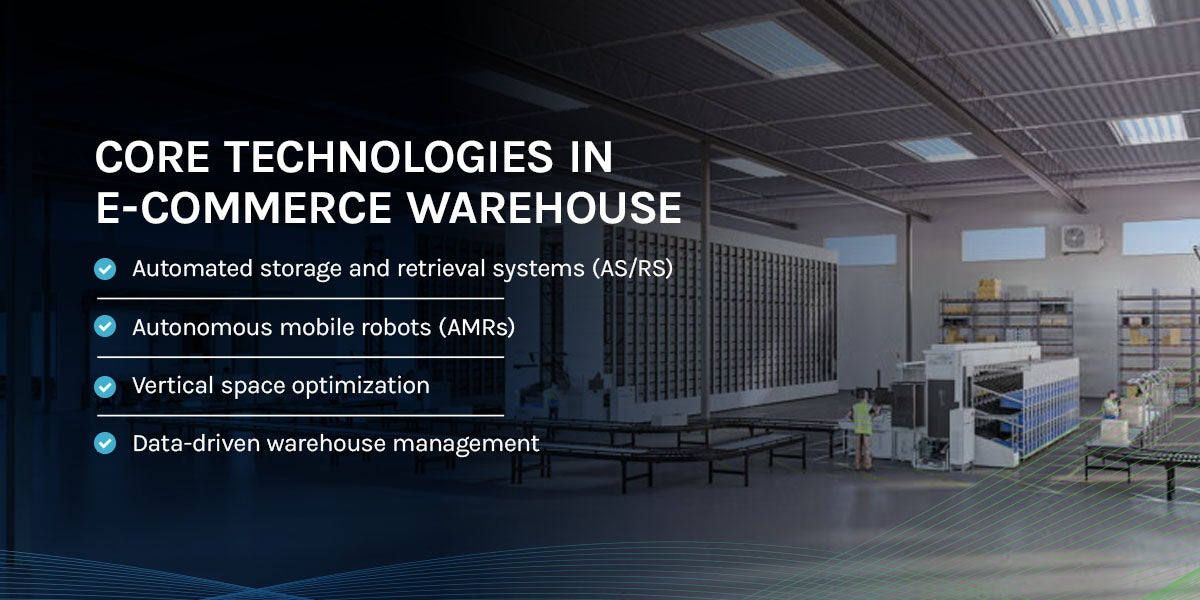
- Automated storage and retrieval systems (AS/RS): AS/RS solutions automatically place and retrieve goods from defined storage locations. These computer-controlled systems use various types of equipment to move products through high-density racks. AS/RS can dramatically increase efficiency by quickening order fulfillment, reducing errors, and increasing storage capacity. These systems are ideal for handling large inventories, as they can operate continuously with high levels of accuracy.
- Autonomous mobile robots (AMRs): AMRs are automated sorting systems that navigate and perform tasks independently. These solutions can transport items to designated locations and respond to layout changes quickly to maintain efficiency. Using sensors, cameras, and AI, AMRs can map environments to avoid obstacles while increasing picking speed and reducing manual labor needs.
- Vertical space optimization: Vertical space optimization solutions maximize warehouse storage capacity by utilizing the warehouse’s full height. These solutions often use vertical lift modules and similar equipment and integrate AS/RS tools for automated access. This solution is valuable for e-commerce businesses with a vast product range and teams looking to scale without expanding their physical footprint.
- Data-driven warehouse management: Data-driven warehouse management focuses on digital warehouse automation. This type of automation relies on software to complete demanding tasks like barcode reading, radio frequency identification, and automatic identification. Automation software can include order fulfillment and inventory management software. Businesses can use a WMS with automation software to cover every aspect of inventory management.
The Future Role of Automation in E-commerce Warehouses
As more businesses embrace e-commerce efficiency automation, more solutions become available to further transform processes. Advancements like AI and the Internet of Things (IoT) offer immense potential for reshaping warehouse operations.
AI can process massive amounts of data to provide predictive analytics. Capabilities like forecasting inventory needs and streamlining supply chain management can enhance overall efficiency. Using machine learning algorithms, these solutions can continuously adapt to changing customer behaviors and market conditions to ensure operations remain informed and agile.
IoT also offers opportunities for boosting efficiency. This solution enhances warehouse connectivity by actively monitoring inventory levels, managing equipment health, tracking shipments, and more. IoT facilitates communication between various supply chain elements, allowing managers to access important metrics at any time.
Key Considerations When Improving E-Commerce Fulfillment With Automation
Automating your warehouse involves a deep understanding of existing workflows and technological needs. With various automated solutions available, it’s crucial to understand which will have the most impact on operations. Consider these critical elements when considering how to improve e-commerce fulfillment:
- Assess operational needs and pain points: Teams must assess current infrastructure and technologies to determine whether there’s enough support to integrate automation. Prioritize updating WMS and existing software solutions before finding advanced tools to complete the existing lineup. Additionally, consider critical elements like order volume and product diversity to understand the types of solutions that can drive the biggest impact.
- Integrate with existing systems and processes: Review different types of automated solutions and determine what combination of technologies will meet your needs. Seamless integration is crucial for connecting all warehouse components with minimal disruption. Create an implementation plan and test the solution, making adjustments as necessary to refine operations.
- Train and deploy change management for staff: Develop comprehensive change management and invest in training opportunities to equip team members with the necessary knowledge and skills. Gather feedback from as many team members as possible to identify potential bottlenecks or shortcomings.
- Maintenance, support, and system reliability: Regular maintenance supports system longevity, allowing teams to maximize life cycles and reduce the risks of unexpected breakdowns. Choose a system provider that offers 24/7 support from trained technicians to be sure you can address concerns promptly.
Find Warehouse Automation Solutions for E-Commerce Businesses
OPEX® is the next generation of automation. With more than 50 years of experience in engineering award-winning solutions, OPEX has the skills and technology to support your operations. Each of OPEX’s systems is flexible and able to accommodate your changing business needs while meeting operational requirements.
The OPEX team offers planning, installation, and implementation services so you can get your operations up and running with peace of mind. At OPEX, your efficiency is our priority. Trained team members will conduct a thorough workflow analysis of your operations to develop solutions that suit your operations.
Start your journey toward warehouse automation by connecting with OPEX.