

In recent years, delivery costs and reliability have become key drivers for American consumers’ purchasing decisions. According to a 2025 McKinsey survey, 90% will likely abandon their carts if they deem the shipping too expensive. Customers also expect on‑time deliveries within the promised window, and 70% want the option to schedule when their order arrives. Though no longer the most critical consideration, speed still matters, especially for fast-moving consumer goods like household or personal care products. To stay competitive, retailers are under pressure to adapt.
Micro-fulfillment centers (MFCs) help companies meet rising customer expectations. For operations professionals, selecting the right fulfillment strategy impacts service levels, costs, and long-term growth potential. This guide details the impact of micro-fulfillment on the retail industry, how your business can benefit, and best practices for a successful rollout.
Micro-Fulfillment Centers: The New Backbone of Retail Efficiency
Micro-fulfillment centers are small-scale facilities that store a limited assortment of fast-moving or high-demand inventory to fulfill local orders rapidly. Unlike retailers’ main warehouses, MFCs are located near demand, most often in urban or suburban areas. They can be stand-alone sites or integrated into existing stores to serve a specific radius. These centers are compact enough to fit into back-of-house spaces.
Here is how MFCs operate:
- Receiving and storing inventory: MFCs accept goods from main warehouses, inspect for discrepancies or errors, and then store and track products via SKU.
- Picking and packing: After receiving customer orders, these centers quickly pick and pack them.
- Shipping orders: Once ready, orders are dispatched to customers.
- Handling returns and exchanges: MFCs inspect and log any damaged items, and then process exchanges and refunds.
With their strategic locations, MFCs are changing retail by accelerating last-mile fulfillment while reducing transportation costs. Equipped with automation technology like automated storage and retrieval systems (ASRS), they streamline key workflows, making same-day — or even same-hour — delivery more economical and feasible. These facilities also expand fulfillment options, including curbside and in-store pickups, and offer real-time inventory visibility. With these benefits, micro-fulfilment has made it easier for smaller e-commerce brands to keep pace with retail giants.
Rising adoption of MFCs, particularly in the e-grocery industry, is fueling the growth of the global micro-fulfillment market. Valued at $3.58 billion in 2022, it is expected to achieve a compound annual growth rate of 34.8% from 2023 to 2030.
5 Benefits of Micro-Fulfillment Centers in Retail
Here is a closer look at five MFC advantages for retailers:
1. Increased Speed
With MFCs, online orders move faster. ASRS, such as goods-to-person and autonomous mobile robots, allow you to speed up picking and packing dramatically, boosting throughput and productivity. This increase in efficiency can cut turnarounds and delivery windows.
Beyond shortening pick-and-pack processes, these centers accelerate delivery by operating near customers. For retailers that exclusively rely on warehouses located in the city outskirts, achieving same-day service can be challenging.
2. Reduced Operating Costs
MFCs can be more cost-effective to operate compared to conventional warehouses.
- Lower labor expenses: MFCs reduce manual processes through automation, which can cut labor costs for your business.
- Optimized inventory: MFCs usually focus on high-demand SKUs, so you can trim carrying costs for slower-moving items.
- More affordable deliveries: Proximity to your customers can shorten routes, reducing shipping-related expenses.
- Improved space efficiency: ASRS can increase storage capacity by using vertical space, allowing you to store more products in a smaller area.
- Reduced overhead: MFCs typically have a more compact footprint and a leaner inventory, cutting operating and real estate costs.
3. Improved Accuracy
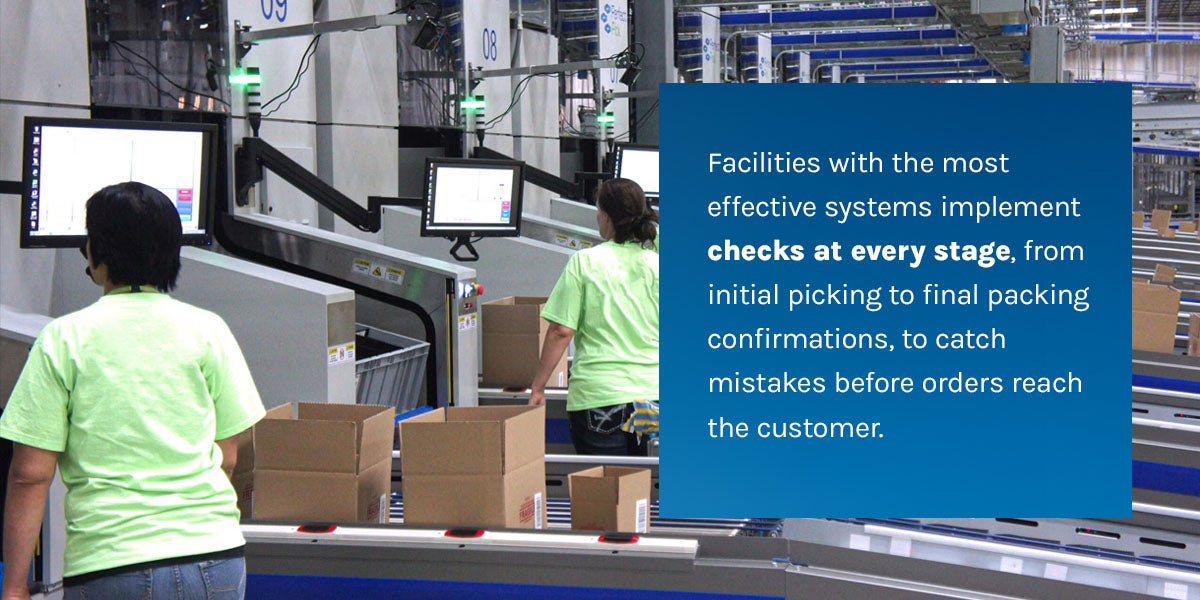
Because MFCs are highly automated, they reduce human error through weight sensors, readers, and system-led workflows. Facilities with the most effective systems implement checks at every stage, from initial picking to final packing confirmations, to catch mistakes before orders reach the customer.
MFCs also integrate with advanced inventory systems that offer real-time inventory visibility. This helps ensure accurate stock counts, avoiding overstocking and stockouts. You can also make rapid, demand-driven adjustments to your business’s stock.
4. Enhanced Scalability
MFCs offer a scalable fulfillment model that expands with your organization. Their replicable design lets you add or clone sites based on demand. Deploying an MFC typically takes less capital and time than building or expanding a large warehouse, allowing for quicker market entry and continuous network adjustments as customer demand changes.
Due to their small and flexible footprint, retailers can deploy MFCs in diverse locations, including back-of-store spaces. This is ideal for those wanting to avoid investing in additional real estate. Additionally, high automation helps you maintain efficiency while managing higher order volumes without proportional increases in labor.
5. Increased Customer Satisfaction
One of the most significant benefits of MFCs is that they boost customer satisfaction. Beyond shortening delivery times to get orders to customers faster, lower operating costs and shorter routes can allow you to provide more affordable shipping. The efficiency and accuracy offered by automation also help ensure the right items are delivered on time.
By storing inventory closer to demand, you can also make pickup options more convenient. Many of these facilities function as dark stores, allowing customers to order online and collect from the closest fulfillment hub or store. This proximity also enables retailers to process returns, refunds, and exchanges much faster, creating a more seamless end‑to‑end experience.
How to Maximize ROI With Automated Micro-Fulfillment
Though MFCs deliver clear advantages, their setup can be capital-intensive — especially if you do not have existing dark stores or brick-and-mortar locations that can be repurposed as distribution hubs. As a result, it is vital to find ways to achieve a high return on investment (ROI) and future-proof your operations.
As the performance of these facilities hinges on automation, results ultimately depend on how well this technology is implemented and used. Choosing the right automation partner is key to achieving the expected returns. With 50 years of experience, you can trust that partnering with OPEX® will help you address current operational goals while preparing for what is next.
OPEX designs, manufactures, and installs proven automation solutions. For example, Sure Sort® is an automated sortation system using iBOT® robots to provide high throughput. Here are the results that Korean health and beauty retailer Olive Young achieved when implementing this system into their first metro‑based MFC:
- A 33% increase in the number of orders completed per person daily
- A productivity lift of up to 60%
- An average of 120 daily orders picked per person
Setting and measuring the correct metrics is also crucial to maximizing ROI. Key performance indicators (KPIs) allow you to assess MFC performance, identify opportunities and inefficiencies, and drive continuous improvement based on the data. Data-driven organizations are as much as 25% more profitable than competitors. While you should prioritize KPIs aligned to your objectives, some of the most essential include perfect order rate, on-time delivery rate, picking accuracy, and cost per order.
Navigating Implementation: Best Practices for Micro-Fulfillment Success
In addition to choosing a reliable automation partner and tracking KPIs, adopt these best practices for retail micro-fulfilment to set your organization up for success:
- Align your inventory management approach: Micro-fulfillment involves a shift in your inventory management approach. While you’ll still maintain your primary distribution center, you’ll need to balance availability across MFCs.
- Develop a network of MFCs: MFCs should be in areas that cut costs and delivery times, so you need to understand where demand clusters are located. Additional factors to consider include zoning compliance, carrier capacity, and highway access.
- Integrate the correct software: A successful micro-fulfillment strategy depends on efficient restocking, so the appropriate inventory software is essential. Along with being compatible with existing systems, the right platform will offer multi-site, real-time inventory visibility to allow for rapid replenishment and accurate planning.
- Hire the right staff: Though MFCs rely on automation, you still need an efficient team with the capacity to manage high order volumes. For example, each site will need staff working on last-mile transportation, from delivery drivers to those managing the fleet.

Equip Your MFCs With OPEX Automation Technology
OPEX is ready to support you in implementing a micro-fulfilment strategy. Beyond providing award-winning automated systems, OPEX helps you realize the full value of technology through consultation, installation, training, and tech support. Contact us today to equip your MFC with next-generation automation.