

60-Second Summary
Organizations are investing in automation and AI while much of their essential information still sits in file cabinets and mailrooms. At ARMA InfoCon 2026, Tim Shields, Business Development Manager at OPEX, led a session on information governance for physical records. He argued that governance begins at capture, and he gave the room five questions to test whether a records digitization program will hold up.
Capture is the First Governance Control
Every system downstream of a scanner inherits whatever happened at capture. A missing page leaves a gap in the digital record. Weak metadata, or a broken link between a letter and its attachments, makes a file hard to find and harder to govern. Search tools, retention schedules, privacy controls, and AI models all draw on the captured record, so a defect at the start shows up everywhere after it.
AI adds risk because a model will summarize or act on an incomplete record with the same confidence it gives a complete one. Tim treated document capture as a records management decision before an operations decision. Scanner speed and a successful batch export tell you little about whether the digital record is complete.
The Five Questions
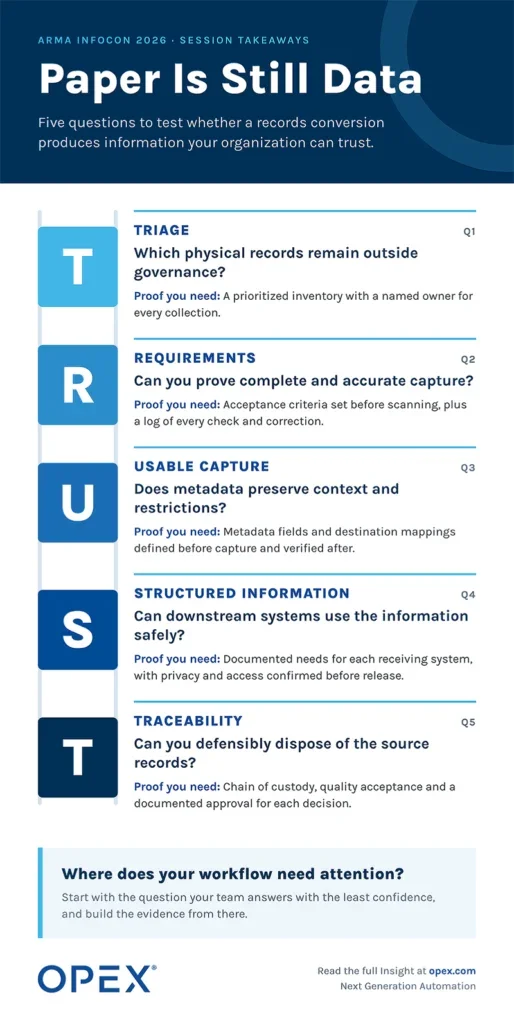
Tim organized the review around five questions. Records managers, legal, privacy, IT, and operations each own part of the answer, so those teams work best when they answer them together.
1. Which Physical Records Remain Outside Governance?
Set the scope before you choose equipment or design a workflow. Inventory each record class: where it is stored, who owns it, and how the business uses it. Rate each collection for sensitivity and retention requirements, and note its physical condition. Flag damaged originals and mixed formats early, since both need special handling.
Each collection raises its own scoping question. Incoming mail needs a record class and an owner for the next step. Legacy files need clear rules about which documents stay together. Sensitive records need access and handling rules that apply during conversion. This step produces a prioritized inventory with a named owner for every collection.
2. What Proves Complete and Accurate Capture?
Agree on acceptance criteria for completeness and legibility before anyone scans the first page, and define what the output files must contain. Run capture as repeatable jobs under a documented quality plan. Keep a record of every quality check and correction.
Exceptions need a controlled route back into the workflow. A page that fails quality review goes to correction and recapture, then returns to review, and a named person owns the outcome. Tim noted that preparation and exception handling often take more effort than the scanner itself. Every time someone handles a folder, page order can shift, or an original can tear. Faster preparation helps only when the source keeps its original order.
3. Does Metadata Preserve Context and Restrictions?
A clean image of a letter shows what the letter says. Metadata records where it belongs: the record type, the case file identifier, the attachments that travel with it, and the access and retention rules that must follow it into the destination system.
When Tim asked attendees how they tell one record from the next during scanning, most named cover sheets or separator sheets, and some index at the point of capture. Whatever the method, define the metadata fields and destination mappings before capture begins. After the files land in the receiving system, check both the content and the links between documents.
4. Can Downstream Systems Use the Information Safely?
This question drew the quietest response of the session. Tim asked how confident attendees were that the file coming off the scanner and into their back-end systems was accurate, and offered a scale from 100% down to 0%. Few hands went up at any point on the scale. One attendee said confidence depends on purpose: a record scanned for reference carries different expectations than one whose data feeds a business process.
Readiness depends on intended use. Define what each receiving system needs from the record. Check legibility, structure, classification, and metadata against those needs, and confirm privacy and access restrictions before anything moves downstream. A digital image alone does not make information ready for AI. Revisit the requirements whenever a downstream use changes.
5. What Supports Defensible Source Disposition?
Many organizations digitize their records and still keep the paper. When Tim asked how many attendees must retain originals after scanning, many hands went up. Retention periods of seven years or longer were common, and some records must be kept permanently. Those organizations pay to convert the records and then keep paying to store them.
Some programs also require originals to go back exactly as they arrived. Before joining OPEX, Tim worked on a project converting Official Military Personnel Files from the National Archives and Records Administration (NARA). Many of the files were 30–40 years old. A single three-prong folder could hold photographs, ID cards, dental records, and medical records, and every item had to return to its original position in the folder. The project needed only a few index fields to make each file findable, but the handling and quality assurance work was intensive.
Disposition also requires someone to sign. One records officer in the audience said they signed about 650 disposition request forms last year and reviewed each one before destroying a record. “We have to put a name on that line, and we’re held accountable,” they said. Another attendee said staff who filled out every form exactly as required would spend the whole day on paperwork, and that gaps open in the parts of the process no one sees.
Scanning alone does not authorize destruction. A defensible disposition decision rests on documented evidence. Chain-of-custody records show which originals entered the process and who handled them. Quality acceptance records show the criteria each digital record met. A documented approval shows who authorized disposition under the applicable retention requirements. If any of that evidence is missing, hold the originals and close the gaps first. Confirm your policies and legal requirements before acting on source records.
Trust: The Framework Behind the Questions
The five questions structure the review. A vendor-neutral framework called TRUST supplies the method behind them:
- Triage: Sort record classes by sensitivity and condition, then set priorities.
- Requirements: Set quality, privacy, output and audit requirements before capture.
- Usable Capture: Produce complete, legible digital records.
- Structured Information: Apply the classification and metadata that downstream systems rely on.
- Traceability: Keep evidence of custody and validation, and document each disposition decision.
Where Does Your Workflow Need Attention?
Tim closed by asking attendees to name two questions: the one they can already answer with evidence and the one that needs the most work. Any team planning a backfile conversion or a mailroom digitization program can run the same exercise. Start with the question your team answered with the least confidence and build the evidence from there.
OPEX has helped organizations automate document and mail processing for more than 50 years, and our team works alongside records and operations leaders to plan capture workflows that hold up to governance review. Let’s talk about where your conversion program needs attention.