

60-Second Summary
Warehouse automation has reshaped the industry by helping teams complete tasks more quickly, safely, and accurately. Automated systems can drastically increase efficiency, reduce overhead costs, and equip teams with the solutions necessary to meet and exceed customer expectations.
Warehouse automation has reshaped the industry by helping teams complete tasks more quickly, safely, and accurately. Automated systems can drastically increase efficiency, reduce overhead costs, and equip teams with the solutions necessary to meet and exceed customer expectations.
However, to make the most of these advanced technologies, warehouses must optimize layouts to support automation integration.
The Importance of Warehouse Layout Optimization
Inadequate warehouse layouts reduce productivity, increase accident risks, and lead to lost or damaged inventory. Poor organization impedes a worker’s ability to pick, pack, and store items effectively. Team members may waste time looking in the wrong location or taking inefficient routes.
Smart designs boost productivity by increasing visibility and creating a safe workplace. Efficient layouts maximize space utilization, which helps streamline inventory management. Combining these benefits can reduce operating costs by lowering labor needs, enhancing safety, and supporting scalability.
Why Optimize Your Warehouse Layout for Automation
Warehouse automation provides peace of mind by delivering consistent operational excellence, while offering measurable value through improved efficiency. Automated systems increase competitiveness, which has a positive impact on customers and the company’s bottom line.
Optimizing a warehouse for automation provides several benefits.
- Faster picking and sorting: Automated systems complete repetitive tasks, such as picking and sorting, that would otherwise be time-consuming and labor-intensive. These systems operate continuously, allowing teams to handle late-day or overnight orders with ease and fulfill same-day delivery services.
- Reduced operating costs: Automation lowers operating costs by reducing labor needs and ensuring efficient operations. Automated systems operate with precision and consistency, completing tasks with minimal risk and little human intervention.
- Increased scalability: Automation equips businesses with the tools and processes to meet peak season demands, overcome labor shortages, and adapt to changing market conditions.
- Enhanced order accuracy: Solutions like automated storage and retrieval systems (AS/RS) enhance order accuracy and speed. These systems can eliminate navigation errors, reduce fatigue-induced mistakes, enable real-time inventory tracking, and guide operators to precise locations to achieve higher accuracy rates.
Tips for Implementing an Automated Warehouse Layout
Optimizing a warehouse for automation involves considering existing workflows and management processes as well as opportunities for addressing inefficiencies.
Several factors influence layout planning. For example, the types of goods a warehouse processes may require various storage methods. The amount and variety of inventory will also influence layout planning, as high-volume warehouses may need different accessibility strategies.
Discover essential tips and key considerations for implementing your automated warehouse layout effectively.
1. Assess Current Operations and Layout
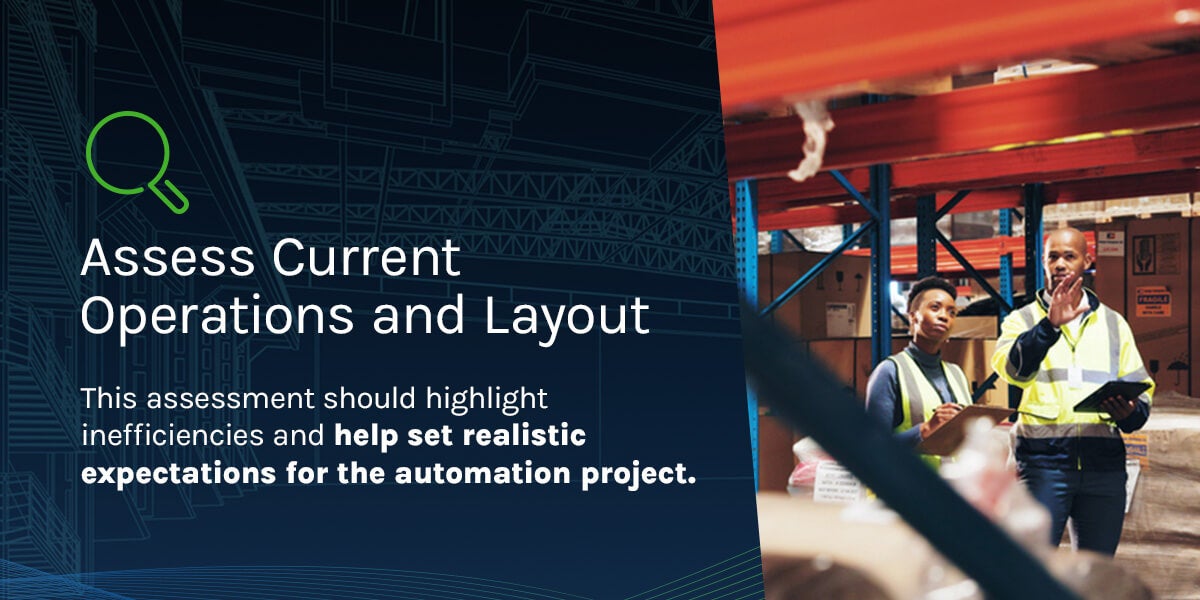
Planning for automation starts with assessing existing processes and layouts. First, map out every workflow step and collect data on order volumes, peak activity periods, inventory turnover rates, and similar pertinent information. Observe how items move throughout the warehouse to identify bottlenecks that automation could address.
Then, create a detailed layout analysis, including aisle width, storage heights, and key infrastructure locations such as offices or loading docks. This information will be crucial for identifying a solution that seamlessly integrates with existing operations and aligns with business objectives. This assessment should highlight inefficiencies and help set realistic expectations for the automation project.
2. Choose the Right Automation Technology
Your choice in automation technology should reflect your operational needs and business objectives. Become familiar with the systems available and consider how technologies can integrate with existing IT infrastructure. Consider these automated solutions:
- AS/RS: These systems maximize space utilization and enhance productivity by automating storage and retrieval tasks. AS/RS solutions optimize vertical space and use tools and equipment like robotic arms and powerful software to optimize picking and inventory management.
- Sorting systems: Automated sorting systems help teams meet rapid delivery expectations. These solutions are scalable and versatile.
- Autonomous mobile robots (AMRs): AMRs are robots that follow predefined routes to navigate warehouses without needing intervention. These robots can assist with tasks like sorting and material transport, and you can use them with sorting and AS/RS systems.
3. Optimize Space Utilization
Space is one of a warehouse’s most valuable assets. Optimizing space utilization allows teams to develop organized processes without expanding their physical footprints.
Analyze inventory profiles to determine which items move the fastest, require special handling, or are seasonal. Use this information to select automated solutions that match product characteristics. For example, AS/RS solutions can increase storage capacity by utilizing vertical space.
Automated solutions can allow for narrower aisles or higher racks, as automated vehicles and robots can operate in tighter spaces. However, teams must balance density with accessibility by ensuring the automated system can retrieve items quickly without creating congestion. Teams may benefit from dynamic slotting strategies, which involve optimizing storage locations regularly based on demand patterns.
4. Streamline Material Flow
Streamlining material flow involves designing logical pathways to support product movements from receiving to storage, picking, packing, and shipping. Map out ideal process flows to minimize unnecessary steps and backtracking. Work with system providers to strategically place technologies like sortation systems, conveyors, and robotic arms.
Use automation to separate inbound and outbound processes. Create staging areas or buffer zones to allow temporary holds without disrupting the main product flow. Integrate the design with a warehouse management system to enable real-time tracking and dynamic routing.
5. Invest in Ongoing Training Programs
Regardless of a solution’s capabilities, you’ll want to prioritize ongoing training and support programs. Teams must invest the time and resources to strengthen worker understanding and experience.
Automated system training ensures every operator can embrace the solution’s full potential. Training should begin before a solution goes live, and leaders should implement ongoing sessions to address process changes as they arise. As systems undergo updates or teams expand services, workers must have the knowledge and skills to maintain efficiency while reducing safety risks.
Optimize Your Warehouse Automation Design
OPEX® is the next generation of automation. With 50 years of experience designing innovative solutions, the OPEX team has become a reliable provider for addressing warehouse complexities.
OPEX’s automated systems support operations by providing efficient solutions that meet operational needs. Ready to optimize your warehouse design? Connect with OPEX to begin the journey.
Other Resources You Might Find Helpful
OPEX® Falcon+® RED One-touch Scanning
Tectel SA Digitizes Medical Records for a Major Hospital with the Document Imaging Solution From OPEX®
Dentegra Dental: Claims Processing System No Longer Feels Like a Painful Root Canal
Falcon® Scanner Demo
EXL: Critical Efficiency Improvements in Document Management
Record Partners Provides High-Volume Critical Record Digitization with New Technology
Portsmouth, VA Treasurer’s Office Goes from Cost Center to Revenue Center
Built for Compliance: How Modern Scanning Systems Deliver Operational Excellence
Husch Blackwell Streamlines the Digital Archiving Process, Reducing Time Needed to Prep and Scan Documents by 50%
Improving Payment Processing at Image Remit® a Division of Cash Management Solutions®
NEXT LEVEL AUTOMATION
Unlock Operational Efficiency with OPEX
OPEX is powering the future of automation. Contact us to learn more about how our vertically integrated automated solutions can help take your business to new heights.