

60-Second Summary
Discover how to design an automated distribution center step by step, from defining operational goals and mapping material flow to selecting technology and managing vendor partnerships. Learn how a phased, data-driven approach maximizes throughput, storage density, and scalability while minimizing risk for a measurable return on investment.
Designing an automated distribution center is one of the most consequential projects an operations professional will undertake. For many, it’s a once-in-a-career opportunity, and these decisions determine whether the facility becomes a competitive advantage or a costly misstep.
This guide provides a clear, actionable framework for how to design an automated distribution center. From defining operational goals and mapping material flow to selecting the right technology and managing vendor partnerships, each chapter addresses a critical phase of the design process. The result: a roadmap that empowers teams to design facilities that are efficient, scalable, and built for long-term success.
The Foundation of a Successful Automated Distribution Center
The planning phase establishes the foundation for every subsequent decision in the design process. For professionals undertaking this project for the first time, comprehensive planning prevents common pitfalls, such as automating the wrong processes or solving symptoms rather than root causes. Clear goals, thorough data analysis, and a well-structured project team determine whether automation delivers measurable results or becomes a costly miscalculation.
Defining Your Operational Goals and Scope
Successful automated distribution center design begins with goals that define what the facility must achieve. Establish measurable objectives for throughput, order accuracy, and storage capacity. Future-proof the facility by planning for growth. Configure automation to accommodate increased SKU counts and seasonal demand fluctuations without major infrastructure changes. With comprehensive planning, organizations avoid over-investing in capacity that remains underutilized or under-investing in technology that cannot scale with demand.
Define which processes to automate based on priorities. Receiving, replenishment, and picking each offer distinct automation opportunities. After mapping SKU profiles and order complexity to identify bottlenecks and high-impact areas, determine whether automation covers the entire warehouse or targets specific zones, such as goods-to-person fulfillment areas.
Gathering and Analyzing Your Operational Data
Data-driven design optimizes robotics and software performance while preventing mismatched technology selections. Collect order profiles, SKU velocity data, and seasonal peak patterns to inform configuration. Throughput requirements, error rates, and space constraints should then be analyzed to establish performance baselines.
Real-time inventory tracking and labor metrics reveal inefficiencies that automation addresses. Analysis of these metrics determines storage density requirements, picking strategies, and technology selection, allowing the facility to handle current volume while accommodating future growth without costly retrofits.
Building Your Project Team
Cross-functional teams drive successful implementations. Include IT, finance, and external consultants or vendors to address technical, financial, and logistical challenges. A dedicated project manager oversees the transition and maintains accountability across stakeholders. Establish feedback loops through regular meetings to track progress and adjust strategies based on performance data.
Designing the Physical Layout
The physical layout translates data and goals into a functional design. Effective distribution center layout planning reduces travel time, maximizes storage density, and supports seamless material flow from receiving to shipping. Strategic layout decisions directly impact market responsiveness, and optimized material flow reduces order cycle time, enabling faster delivery and stronger customer retention.
1. Principles of Warehouse Layout Design
Distribution center design best practices follow the F.A.C.T. framework:
- Flow ensures goods, people, and equipment move in logical, nonoverlapping paths.
- Accessibility places high-velocity items near shipping areas to reduce travel distance and cycle time.
- Capacity uses high-density storage and vertical space while maintaining up to 85% utilization to allow movement and flexibility.
- Traceability implements technology that tracks every action and item, delivering accuracy and accountability.
2. Mapping Your Material Flow
Mapping material flow identifies bottlenecks, eliminates non-value-adding activities, and accelerates delivery timelines. Visualizing the path from receiving through storage, picking, packing, and shipping reveals inefficiencies that automated equipment resolves. Inefficient flow patterns increase labor costs and slow fulfillment speed, undermining the competitive advantages automation should deliver.
Different flow patterns suit different facilities. U-shaped layouts consolidate receiving and shipping at one end. L-shaped designs separate functions while maintaining proximity. Straight-through configurations maximize speed for high-volume facilities with minimal storage requirements.
3. Space Planning and Maximizing Storage Density
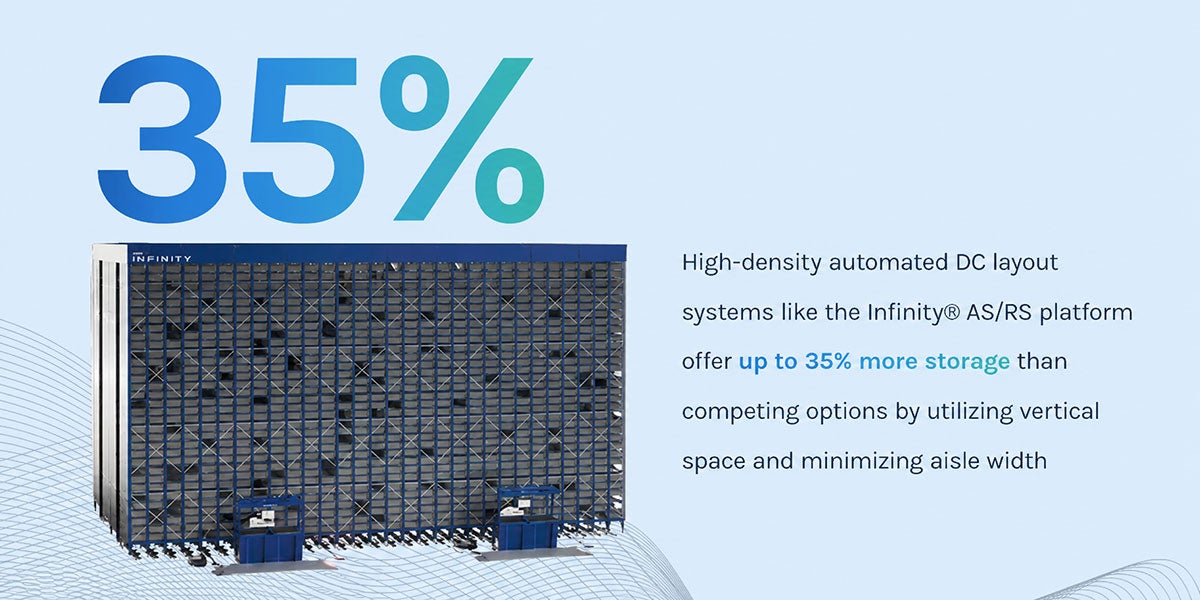
Calculate space requirements based on SKU count, order volume, and inventory turnover rates. High-density automated DC layout systems like the Infinity® AS/RS platform offer up to 35% more storage than competing options by utilizing vertical space and minimizing aisle width. High-velocity items require immediate access, while slower-moving inventory can occupy denser storage zones.
Selecting the Right Automation Technology
The right warehouse automation design matches functionality to throughput goals, order profiles, and scalability needs. Mismatched technology selections result in underutilized equipment and limited capacity to scale as business demands grow.
Understanding the Different Types of Warehouse Automation
Warehouse automation encompasses automated storage and retrieval platforms (AS/RS), sorting solutions, and autonomous mobile robots (AMRs). AS/RS technology optimizes vertical storage and retrieval. Goods-to-person solutions bring inventory to stationary workers, increasing picking speed and accuracy. Sorting equipment automates order consolidation for high-volume fulfillment.
Explore comprehensive automation options in The Ultimate Guide to Warehouse Automation.
Matching Technology to Your Operational Needs
Align technology selection with the data and goals established in the planning phase. E-commerce facilities benefit from goods-to-person systems, which accelerate order fulfillment while minimizing labor costs. High-volume facilities requiring rapid order consolidation leverage sorting equipment, designed for small-item sorting and cross-docking applications.
When evaluating throughput capacity, scalability, and integration requirements, select technology to handle peak demand without over-investing in capacity that remains underutilized during slower periods. Configurable automation that scales with demand prevents costly retrofits as market share expands.
Integrating Your Warehouse Management System (WMS)
Software integration is critical for maximizing automation performance. WMS and warehouse control platforms coordinate real-time communication between robotics, conveyors, and inventory management tools. Integration like this boosts picking accuracy and reduces manual input. Some platforms integrate with various automation technologies, providing centralized control and performance monitoring across the facility.
Your Roadmap to Implementation and Beyond
Successful rollout requires phased implementation, effective vendor management, and continuous performance monitoring.
Creating a Phased Implementation Plan
Phased implementation minimizes risk and generates rapid ROI. Establish a data-driven baseline before investing in hardware, then launch pilot programs to test feasibility and generate quick wins. Scale successful pilots across the facility and integrate technology for enhanced workflow automation. Finally, optimize fully automated operations through continuous improvement initiatives. Consult resources on successful technology integration to refine implementation strategies.
Managing the Project and Your Vendor Relationships
Effective project management and vendor collaboration drive implementation success while preventing delays and scope creep.
- Define clear, outcome-focused charters with measurable objectives.
- Integrate vendors into planning to leverage their expertise during design phases.
- Use centralized communication platforms to maintain transparency and automate reporting for real-time visibility.
- Implement data-driven performance metrics to track KPIs and identify improvement opportunities while standardizing processes for flexibility.
Measuring Success and Driving Continuous Improvement
Track key performance indicators to validate automation investments and identify optimization opportunities:
- Order accuracy rate: Measures precision to minimize returns and improve customer satisfaction.
- Order fulfillment speed: Tracks total time from order placement to dispatch.
- Return on investment: Calculates cost savings and profitability of automation projects.
- Storage utilization rate: Measures how effectively the facility maximizes available space.
Continuous improvement transforms automation from a one-time investment into a sustained competitive advantage. Regular performance reviews, user feedback, and technology updates allow the facility to adapt to evolving demands and maintain market leadership.
Learn More From OPEX®
An automated distribution center requires a partner who understands warehouse automation and can deliver configurable, high-performance solutions tailored to specific needs.
OPEX® provides a comprehensive technology stack, including automated storage and retrieval platforms, goods-to-person systems, and sorting equipment designed to maximize throughput and storage density. OPEX supports professionals from initial concept through post-installation optimization.
Contact OPEX to discuss your distribution center design challenges and explore how configurable automation can deliver measurable results.
Other Resources You Might Find Helpful
Streamlining Operations: The Impact of Automation on Financial Institutions
The SPS & OPEX Partnership: Optimising Technology for World Class Solutions
Security Considerations in Retail Warehouses (and How to Overcome Challenges with Automation)
How Intelligent Scanning Cuts Costs and Drives ROI for BPOs
SPS and OPEX® Falcon+® RED® Document Scanners Provide Digitization at Sanitas
Sure Sort: Dependable Solutions in an Uncertain World
Calculating Your ROI – Justifying Investment in Intelligent Document Scanners
Feeding the Data Warehouse: Integrating Scanned Document Data for Comprehensive Analysis
Unleashing the Power of Legacy Data in Your AI Journey
Serving Everyone: Using Scanning to Improve Access for Citizens
NEXT LEVEL AUTOMATION
Unlock Operational Efficiency with OPEX
OPEX is powering the future of automation. Contact us to learn more about how our vertically integrated automated solutions can help take your business to new heights.